

Booking entertainment for a bachelor party, birthday bash, or private event should be exciting, not stressful. Yet every year, thousands of people hand over their money to fraudulent agencies and never see a performer show up at their door. If you are new to hiring private entertainment, knowing how to avoid stripper agency scams is one of the most important skills you can develop before making any payment.
The private entertainment industry, while largely professional and legitimate, does attract a small number of dishonest operators who prey on first-time customers. These bad actors use polished websites, fake reviews, and persuasive sales tactics to collect deposits and disappear. The good news is that spotting the red flags is not complicated once you know what to look for.
In this guide, you will learn the key signs that separate trustworthy agencies from fraudulent ones, what questions to ask before you book, and how to protect your money throughout the entire process. By the end, you will feel confident making an informed decision and securing a genuine, professional experience for your event.
Why This Industry Attracts Bad Operators
Private entertainment bookings carry a structural feature that bad operators understand very well: once the event date passes, the customer has almost no practical leverage. You are not returning a product or canceling a subscription. The bachelor party happened, the night is gone, and whatever was promised versus delivered becomes very difficult to dispute after the fact. This irreversibility is not an accident that scammers stumble into; it is the specific condition they look for. The FTC’s consumer scam resources consistently identify urgency and irreversibility as the two preconditions that allow fraudulent operators to function with low accountability.
Most people booking this type of entertainment are doing it for the first time. A professional-looking website, a polished Instagram presence, and a booking form that resembles a legitimate checkout process are often enough to establish false credibility with a first-time buyer. Without a prior experience to benchmark against, there is no obvious way to know whether a quoted price is real, whether the performer photos are genuine, or whether the “agency” is a single person reselling leads to whoever picks up the phone. The Canada Competition Bureau’s fraud guidance notes a parallel pattern in adult venue bookings, where fake promoters use social media advertising to move customers into non-refundable prepaid packages before they have time to verify anything.
Three conditions converge in this booking category in a way that rarely lines up so cleanly elsewhere. There is genuine time pressure, since most bookings happen within days of the event. There is consumer inexperience, since the majority of buyers have never done this before. And there is social awkwardness, since many people feel uncomfortable researching the topic openly, asking friends for referrals, or filing a public complaint afterward if something goes wrong. That reluctance to seek help or report problems creates an enforcement gap that dishonest operators rely on deliberately.
Seasonal timing compounds the risk. Those windows align almost exactly with when bachelor and bachelorette parties are booked at the highest volume. Fly-by-night operators enter the market precisely when demand is highest and consumers are most rushed.
The fact that legitimate, established adult entertainment venues now publish formal consumer warnings is worth noting as a signal of scale. The published warnings from established adult entertainment venues call out fake VIP promoters, promises of unlimited drinks at suspiciously low prices, and mandatory service charges revealed only on arrival. When credible, long-standing businesses feel it is necessary to educate their own customers about fraud, the problem is not a fringe concern; it is industry-wide and well-documented heading into 2026.
What a Lead-Resale Broker Is and Why It Creates Risk
A surprising number of websites that appear when you search for private entertainment booking are not agencies at all. They are lead-collection funnels. Their actual business model is simple: capture your inquiry, take your deposit, and route your information to whoever is available in your area and willing to accept the job. The person who confirms your booking by email may have never spoken to the performer being sent to your event. This structure has a formal name in regulatory circles; the FTC has pursued enforcement actions against data broker operations using this exact model, including a case where a lead-resale network collected financial information from more than 500,000 consumers and routed it to third parties who raided accounts for over $7 million, per the FTC charges data brokers with helping to scam $7 million from consumers report. The consumer in each case believed they were dealing with a legitimate, accountable provider. They were not.
The accountability gap this creates is the real problem. When no single person on the booking side has vetted the performer, confirmed the event details, and put their name on the outcome, there is no internal mechanism to ensure that what was advertised matches what actually arrives at your door. Bait-and-switch is not just possible in this model; it is structurally easy. The website that collected your payment can disclaim responsibility by pointing to the independent third party they routed your booking to, and that third party has no binding commitment to the profile, photos, or pricing you originally agreed to. The FTC maintains a formal Penalty Offenses framework targeting bait-and-switch conduct precisely because the harm is predictable and well-documented across industries.
Paid search advertising makes this worse. Broker-model sites routinely purchase ads against search terms for legitimate local providers, intercepting customers who are specifically trying to find a direct, accountable business. The FTC flagged this tactic explicitly in its Roomster complaint, noting that deceptive intermediaries advertise on external platforms to pull consumers away from legitimate services and into a lead pipeline. By the time you realize the site ranking at the top of your search is not the agency it presents itself to be, you may have already submitted a deposit.
The structural difference between a broker and a direct agency is not subtle. A direct agency has one person who books the event, confirms the performer, communicates with you by name, and is reachable if something goes wrong. A broker operation functions like a call center; your inquiry is a data point passed to whoever picks up. When you are booking a one-night event with no possibility of a refund after the date passes, that distinction matters more than almost any other factor in your evaluation process.
The Most Common Bait-and-Switch Patterns in Private Bookings
Knowing what these patterns look like in practice is the most effective defense you have before committing to any booking.
Mismatched performer photos are one of the most reported problems in private entertainment bookings. An agency presents polished, professional images during the sales process, but the person who arrives at your event does not resemble those photos in any meaningful way. Photos may be heavily filtered, borrowed from other sources, or simply not representative of who actually shows up. By the time you realize the mismatch, your event has already started and your options are limited.
Hidden fees disclosed at the door follow a predictable structure. A rate is quoted during booking that sounds reasonable. What that quote quietly excludes are travel charges, processing fees, or mandatory gratuity minimums that only surface when the performer arrives or in fine-print contract language most buyers never read carefully. These additions can meaningfully inflate the final cost well beyond what you agreed to.
On-arrival cash demands take this further. Some performers, working with bad-faith operators, will request additional payment in cash once they are already at your venue, citing reasons that were never part of the original agreement. The timing is deliberate; mid-event, with guests present, most hosts feel they cannot refuse without ruining the night.
Artificial urgency phrases are a recognized manipulation tactic across entertainment and travel booking contexts. According to consumer scam guidance from Billings, Montana’s city government, pressure to pay immediately before you can verify a service provider is a defining feature of fraudulent operators. Phrases like “last available date in your city” or “this rate expires in an hour” exist specifically to prevent you from pausing long enough to confirm the agency is legitimate.
No-show incidents are the most damaging outcome. Prepayment is collected, the event date arrives, no performer shows up, and the phone number you have on file stops accepting calls. Because payment was made through non-reversible methods, recovery is difficult. The FTC notes that scammers in event-adjacent categories consistently exploit time-sensitive bookings, knowing that urgency reduces a buyer’s due diligence window.
Each of these patterns is avoidable once you know what question to ask and what documentation to require before any money changes hands. The next sections walk through exactly that process.
Red Flags to Watch Before You Pay Anything
Once you move past understanding how bad operators are structured, the next step is knowing exactly what to look for before you hand over any money. These five signals are consistent across every category of entertainment booking fraud, and each one is actionable on its own.
Payment method demands that eliminate your protection. Any agency that accepts only cash, Venmo, Zelle, or cryptocurrency is removing your ability to dispute a charge if the booking falls apart. The CFPB identifies pressure to use untraceable payment methods as a classic warning sign across all service industries. Legitimate agencies with real operating histories accept standard payment methods and provide written receipts. Cryptocurrency is particularly high-risk because transactions are irreversible and anonymous by design. If there is no paper trail, there is no recourse.
Pricing that only appears after you make contact. A site with no published rates is not being discreet; it is keeping the price flexible until it knows how much pressure you are under. This mirrors a well-documented tactic in venue-based entertainment where a low advertised number becomes a much larger bill after service fees and minimums are layered on. If you cannot find a rate range anywhere on the website before calling, treat that as a structural warning, not an inconvenience.
Urgency language designed to prevent research. Phrases like “last available performer in your city” or “this date will be gone by tonight” are not sales language; they are manipulation mechanics. The FTC consistently flags artificial scarcity as a tactic used specifically to prevent buyers from verifying a business before committing. A legitimate agency understands that your event matters and will give you time to review what you are booking. Any operator who treats a five-minute research window as a threat to the deal is telling you something important about how they operate.
No verifiable business history. An agency with no reviews older than twelve months, no named owner, no physical address, and no media or press record has none of the verification anchors that accumulate over time for real businesses. Community members navigating entertainment vendor bookings consistently recommend checking Google and Yelp specifically because those platforms make reviews harder to fabricate or remove. If a business name returns nothing credible when you search it outside their own website, that absence is itself a data point.
Social media as the only contact surface. Fraudulent promoters operate primarily through social media ads offering deals that do not exist once payment clears. An operation with no functioning website, no listed phone number, and no named owner attached to the business has removed every accountability anchor that would allow you to seek recourse after paying. A professional agency maintains a real web presence, answers a real phone line, and can name the person responsible for your booking.
For booking guidance from an agency with a published track record going back decades, visit Hot Party Stripper. For city-specific entertainment options, explore availability directly through Hot Party Stripper.
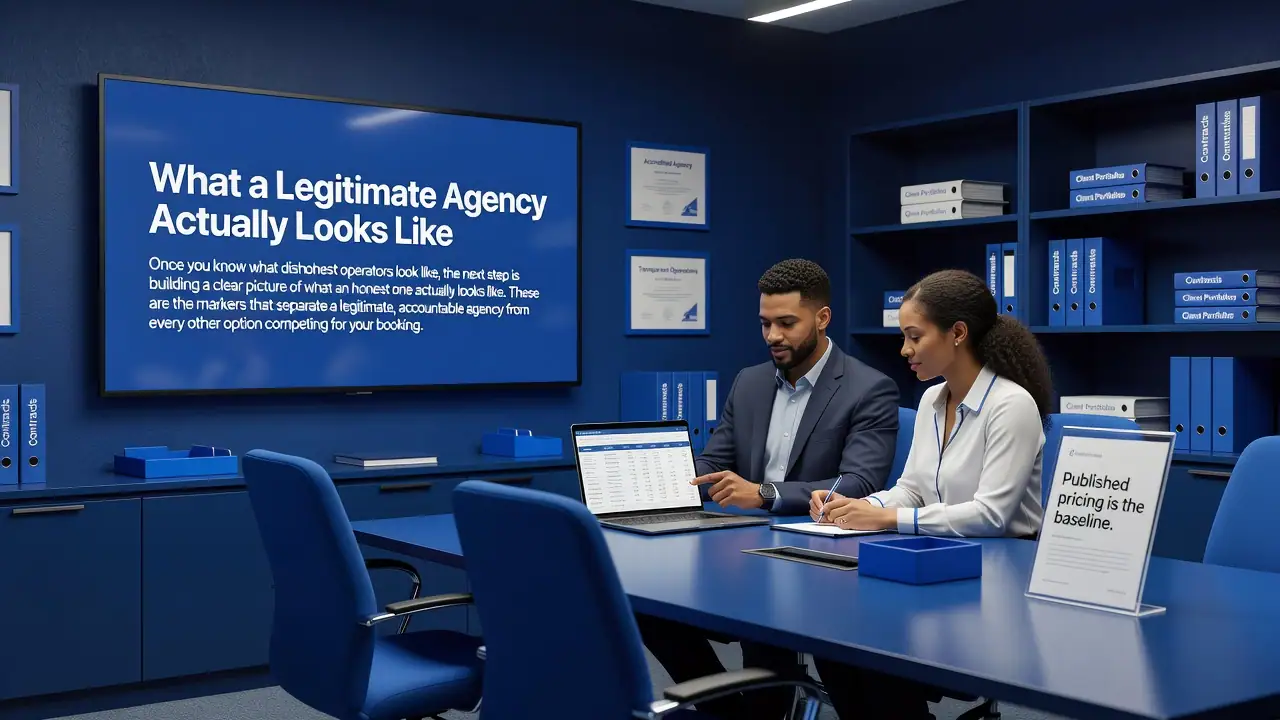
What a Legitimate Agency Actually Looks Like
Once you know what dishonest operators look like, the next step is building a clear picture of what an honest one actually looks like. These are the markers that separate a legitimate, accountable agency from every other option competing for your booking.
Published pricing is the baseline. A legitimate agency lists its rates, packages, and what is included before you ever call or fill out a form. If you have to make contact to get a number, that is not a transparency-first operation. Pricing that only appears after a date is confirmed, or that shifts once you have emotionally committed to a performer or package, mirrors the exact pattern the Washington State Attorney General identifies in acting and modeling scams: fees that materialize only after the client is already invested.
There is a named person running the operation. Not a chat widget, not a call center, not a generic business name with no individual attached. A real agency has an identifiable owner whose professional background can be searched and verified. Per consumer protectin resources on talent agency fraud, scam operations frequently rotate business names and locations specifically to stay ahead of complaints. A named operator with a traceable, multi-decade professional record cannot do that.
History you can actually verify. Years in business, media appearances, named performers, named events; these are things a legitimate agency can point to and you can independently confirm. A website with no verifiable history, testimonials built on stock photography, or an online presence under two years old are all documented warning signs. Agencies that have been operating for decades leave a real paper trail.
Performers are vetted by the agency itself. Sourcing on-demand from whoever responds to an outreach message means the agency has no real accountability for who shows up at your event. A professional agency maintains an in-house roster, knows its performers personally, and stands behind the match between what was booked and who arrives. As industry scam awareness resources note, a legitimate operation makes money by delivering on its commitments, not by collecting fees before any commitment is actually met.
Local presence is not optional in high-traffic markets. In cities like Miami, Fort Lauderdale, Nashville, and Scottsdale, the volume of one-night visitors creates exactly the conditions that allow a bad-faith operator to cycle through customers before reputation catches up. A nationally brokered service with no real footprint in your destination city has no local accountability and no local relationships. A tenured, locally operating agency in those same markets has its reputation on the line with every single booking, which is a meaningful and verifiable structural difference.
For events in any of those cities, Hot Party Stripper offers a direct booking structure with published packages and owner confirmation on every reservation. You can also browse full service details through Hot Party Stripper before making any contact.
A Quick Checklist Before You Confirm Any Booking
Before you confirm any booking, run through each of these six questions. A legitimate agency will clear all of them without hesitation.
1. Can you find the owner by name outside the agency’s own website? Search the owner’s name independently. Look for press coverage, licensing records, social media profiles, or business registrations that exist outside the agency’s own pages. If a name search returns nothing but the agency’s site, treat that as a significant concern.
2. Is pricing published openly? Baseline rates should be visible without a required call or inquiry. Any site that withholds pricing to start a conversation is using a soft-pressure tactic the FTC specifically flags as common among fraudulent service operators.
3. Does the agency accept standard payment methods and provide written confirmation? Credit cards, which allow chargebacks, are the standard for legitimate bookings. Requests for wire transfer, Cash App, or gift cards, combined with no written receipt, match documented fraud patterns exactly.
4. Are performer photos verifiable? Run a reverse image search on any photo presented. Consistent, professionally documented images tied to real social profiles are a reliable signal. Stock-style images with no traceable history are not.
5. Does one direct contact manage the full booking? The person you reach on first contact should be the same person confirming your event. If contact shifts to WhatsApp or a different number after inquiry, that is a recognized handoff pattern in brokered and fraudulent booking operations.
6. Does the agency have a documented business history? Look for reviews predating the last 12 months, press mentions, and third-party directory listings. Short-lived operations with only recent five-star reviews and no verifiable registration history warrant skepticism regardless of how professional the website looks.
If any answer is unclear or missing, keep looking. For guidance on booking a fully vetted, owner-confirmed event, visit Hot Party Stripper.
Why Booking Directly With an Owner Changes Everything
Everything in the previous sections comes down to one structural question: who is actually accountable when your performer either shows up or doesn’t?
When the person who answers the phone is the same person who founded the agency, vetted every performer on the roster, set the published rates, and will personally confirm your booking, there is no gap in the chain where accountability can quietly disappear. A broker who resells your inquiry to whoever answers has no stake in your event’s outcome. An owner who built the business does.
This is not a subtle distinction. Owner-operated agencies carry their reputation into every single transaction. The owner’s name is attached to the outcome in a way that a call center’s never will be. If a performer no-shows or the photos don’t match, a named owner with a verifiable professional history has something real to lose. An anonymous reseller does not.
Booking Travel Online? Here’s How to Avoid Fake Travel Agencies outlines the same principle across service industries: legitimate businesses are identifiable, traceable, and have a documented record that exists independently of their own marketing. That standard applies here.
Hot Party Stripper is operated directly by Sean Michaels, a 36-year industry veteran whose background is independently searchable before you spend a single dollar. His career includes performing with Chippendales, co-founding the first two LaBare locations in Florida, and appearing on more than 200 television programs. None of that is a marketing claim you have to take on faith; all of it surfaces through a standard Google search conducted before you book.
The agency’s operational record of more than 21,000 direct bookings since 1989 represents documented history, not a number pulled from a brochure. That volume, combined with a publicly named owner and an online presence dating to 2007, produces exactly the kind of independently verifiable footprint that the checklist in the previous section was designed to find.
Applying that checklist to Hot Party Stripper produces a straightforward result: named owner confirmed, published pricing confirmed, verifiable history confirmed, direct contact confirmed, in-market presence across 32+ U.S. cities confirmed. That is how the verification process is supposed to work, and it is the clearest demonstration that the steps outlined above are practical, not theoretical.
For more information on booking a vetted, owner-confirmed private event, visit Hot Party Stripper. For city-specific availability and packages, Hot Party Stripper publishes all pricing and details directly on the site.
Book With Confidence, Not With Crossed Fingers
The process outlined in this guide comes down to four fast checks that any host can complete in under ten minutes. Named owner, published pricing, verifiable history, and standard payment methods: if an agency clears all four, you have a strong foundation for a confident booking. If it fails even one, the answer is simple. Move on.
No website design, no compelling rate, and no urgency message changes that math. Polished creative and low prices are the two most common covers for bad-faith operators, and both are cheap to produce. The checks described here cut through both.
If you are ready to book with an agency that passes every one of those tests, Hot Party Stripper has published pricing, a named owner with a 36-year verifiable record, and direct confirmation on every reservation. You can also browse availability for your specific city through Hot Party Stripper to get started without any guesswork.
Conclusion
Booking private entertainment does not have to be a gamble. By verifying an agency’s credentials, reading reviews across multiple platforms, insisting on a written contract, and never paying the full amount upfront, you dramatically reduce your risk of falling victim to a scam.
The most trustworthy agencies welcome your questions, provide clear documentation, and communicate professionally from the very first contact. Any operator who pressures you to pay quickly or avoids putting terms in writing is a serious red flag worth walking away from.
Your event deserves performers who show up, deliver on their promises, and make the night memorable for all the right reasons. Take the time to do your homework, trust your instincts, and book with confidence. A little due diligence today means a stress-free celebration tomorrow.